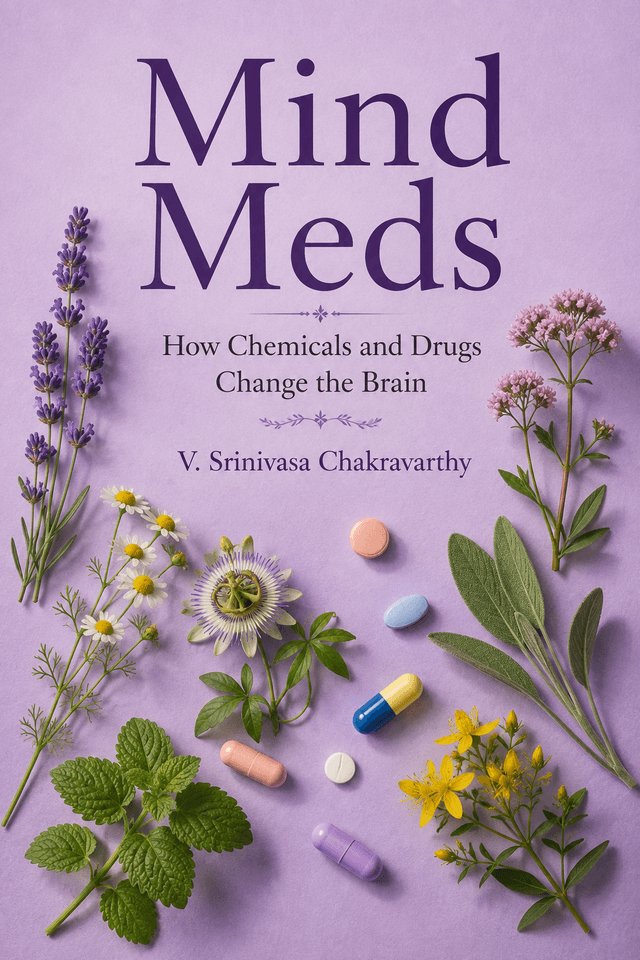
Mind Meds
How Chemicals and Drugs Change the Brain
Prof. V. Srinivasa Chakravarthy
“How can a few milligrams of a chemical alter movement, motivation, fear, attention — or even the experienced structure of reality? Mind Meds follows the story from molecules and receptors to circuits, learning, behaviour and the mind.”
About the book
Mind Meds traces the story of neuropharmacology from ancient poisons, plant extracts and intoxicants to receptors, neurotransmitters, synapses and modern psychiatric medicines. It explores how drugs acting on dopamine, serotonin, GABA, glutamate and other chemical systems influence movement, mood, attention, motivation, learning, perception and behaviour.
But the book goes beyond simple "chemical imbalance" explanations. It follows drug effects upward from molecules and receptors to circuits, network dynamics, plasticity and experience — showing why a treatment mechanism is not necessarily the cause of a disorder.
The result is a systems-level view of mind medicines, and of how chemistry can reshape a living, adaptive brain.
Molecule to mind
Follows drug effects across levels: molecule → receptor → synapse → circuit → network dynamics → behaviour → experience.
Beyond chemical imbalance
Challenges oversimplified ideas like "dopamine = pleasure" and explains why treatment mechanisms differ from disorder causes.
From ancient to modern
Traces neuropharmacology from ancient plant extracts to modern psychiatric medicines and receptor pharmacology.
Who this is for
Mind Meds is written for readers who want to understand how brain chemicals and psychoactive drugs actually work, without needing specialist training in pharmacology.
It is especially suited to students of neuroscience, psychology, medicine and related fields; clinicians and researchers who want a broader systems perspective; and scientifically curious general readers interested in mood, motivation, attention, addiction, perception and psychiatric medicines.
The book assumes curiosity rather than advanced expertise. It explains receptors, neurotransmitters and drugs, but continually connects them to circuits, learning, behaviour and experience. It is an educational science book, not a prescribing manual or a substitute for clinical advice.
The Purpose Behind the Pages
Books about neurochemistry often begin with neurotransmitters and receptors and stop close to the molecular level. Mind Meds asks a larger question: how does a chemical intervention become a change in movement, mood, motivation, attention, learning — or even the experience of reality?
The book follows that chain across levels: molecule → receptor → synapse → circuit → network dynamics → behaviour → experience. Along the way, it shows how drugs helped reveal the workings of the nervous system, why familiar ideas such as "dopamine = pleasure" or "depression = low serotonin" are too simple, and why the mechanism through which a treatment works is not necessarily the mechanism that caused the disorder.
The aim is therefore not simply to catalogue mind-altering drugs, but to use them as windows into the brain — and to develop a more modern view in which chemistry acts within plastic, adaptive neural systems.
Contents
Chapter 1. Before Neurotransmitters: Humanity Experiments on the Nervous System
Preface
Long before anyone knew what a neuron was, human beings had already learned how to alter the nervous system.
They discovered that certain plants could dull pain, induce sleep, sharpen alertness, paralyse an animal, produce visions, change appetite, ease fear or generate euphoria. Curare tipped hunting arrows. Opium relieved suffering. Tobacco stimulated and soothed. Coca reduced fatigue.
None of the people who first used these substances knew about synapses, receptors, ion channels, neurotransmitters or brain circuits. They knew only the effects.
In a sense, therefore, humanity practised neuropharmacology before neuroscience existed.
The drug often came first. A poison caused paralysis, and scientists asked where the paralysis occurred. A plant alkaloid mimicked a nerve signal, and physiologists wondered whether the nerve itself might normally use a chemical messenger. From such observations gradually emerged the concepts of receptors, neurotransmitters and chemical synapses.
Drugs therefore did more than become medicines. They became experimental tools.
— From Mind Meds
Free sample
Chapter 18 — The Chemical Imbalance That Wasn't
Read a full chapter before the book launches
Excerpts
Chapter 7 — Dopamine: Movement, Motivation and Learning
“Dopamine is perhaps the most over-cited molecule in popular neuroscience. It has been called the pleasure chemical, the reward molecule, the motivation transmitter and the currency of desire. Almost none of these descriptions is precise enough to be useful. Dopamine does not signal pleasure directly. What it signals, in the circuits that matter most for reward, is something closer to a prediction error — the difference between the outcome that was expected and the outcome that actually occurred.”
Chapter 18 — The Chemical Imbalance That Wasn't
“The chemical-imbalance hypothesis was never quite the settled science that its popular presentation suggested. It was always more a useful shorthand than a mechanistic account. What the drugs actually do, and what that tells us about what went wrong, turns out to be considerably more interesting — and considerably more complicated — than "too little serotonin" or "not enough dopamine".”
Chapter 17 — Psychedelics: Chemistry and the Construction of Reality
“Under a psychedelic, the ordinary boundaries of perception become uncertain. Colours may seem to emanate from objects rather than to be reflected by them. Time can appear to slow, accelerate or lose its linear character. The self — that sense of being a continuous subject located somewhere behind the eyes — can become fluid, fragmented or temporarily absent altogether. These are not distortions of reality in the ordinary sense. They are alterations in how reality is constructed.”

About the author

Prof. V. Srinivasa Chakravarthy
Professor of Biotechnology, IIT Madras
V. Srinivasa Chakravarthy is Professor of Biotechnology at the Indian Institute of Technology Madras, where he leads research in computational neuroscience and brain-inspired modelling. His work spans basal ganglia function, reinforcement learning, Parkinson's disease, neurotechnology and computational approaches to brain disorders.
He is the author of the Springer books Demystifying the Brain and Computational Neuroscience Models of the Basal Ganglia, and has written extensively for both scientific and general audiences.
He is also the founder of Neurogati and Neurovidya, initiatives aimed at translating neuroscience into education, technology and accessible public understanding. In Mind Meds, he brings a computational and systems-neuroscience perspective to neurochemistry and psychopharmacology, connecting molecules and receptors to circuits, learning, behaviour and experience.
Mind Meds
Get notified when it launches