Neural Signal Processing
Neural signal processing is the discipline of capturing the brain's electrical activity, removing what does not belong in it, and extracting information that can be interpreted or acted on.

Prof. Srinivasa Chakravarthy
Co-founder & Chief Scientist, Neurogati. Professor, IIT Madras
.png&w=3840&q=75)
About the Course
The course begins with the origin of a biosignal itself: the resting membrane potential, the action potential, and how this activity is expressed differently depending on the scale at which it is recorded. It then follows a signal through the complete acquisition chain of electrodes, amplification, and sampling including the electrical safety considerations any real recording system must satisfy. A substantial part of the course addresses noise and artifacts, since no real recording is clean; participants learn to identify physiological and environmental sources of contamination and apply detection and removal methods that preserve the underlying signal. The course then moves into frequency-domain analysis: the Fourier transform, the Nyquist sampling principle, and the standard neural frequency bands, extended into nonstationary methods — the short-time Fourier transform, spectrograms, wavelet analysis, and event-related potentials for signals whose character changes over time. Filtering is treated as a practical design decision throughout, with low-pass, high-pass, band-pass, notch, and moving-average filters each tied to the specific problem they solve. The course closes by applying these methods across the major recording modalities in neuroscience — EEG, ECoG, EMG, EOG, spikes and local field potentials, and MEG — and assembling them into a complete signal-processing pipeline. By the end of the course, participants will be able to take a raw neural recording, understand its contents, clean it, analyze it in both time and frequency, and extract information from it with confidence.
What You'll Learn
Acquire and Clean Neural Recordings
Follow a signal through the complete acquisition chain — electrodes, amplification, and sampling — and learn to identify, detect, and remove noise and physiological artifacts without degrading the underlying signal.
Analyze Signals in the Time and Frequency Domains
Build a working grasp of the Fourier transform, the Nyquist sampling principle, and the standard neural frequency bands, then extend this to nonstationary methods — the short-time Fourier transform, spectrograms, wavelets, and event-related potentials.
Apply These Methods Across Neuroscience Recording Modalities
Apply the same analytical framework across EEG, ECoG, EMG, EOG, spikes, local field potentials, and MEG, and assemble these methods into a complete neural signal-processing pipeline.
Meet Your Instructor
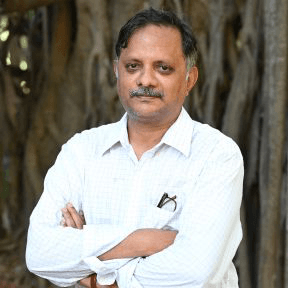
Prof. Srinivasa Chakravarthy
Co-founder & Chief Scientist, Neurogati. Professor, IIT Madras
Prof. Srinivasa Chakravarthy is a distinguished neuroscientist at IIT Madras with over 25 years of research experience. As the Head of the Computational Neuroscience Laboratory, his work focuses on computational neuroscience, brain-inspired systems, and neurotechnology applications.
One-time payment · Lifetime access
- ✓ 7 chapters · 39 lessons
- ✓ Certificate of completion
- ✓ Access on all devices
- ✓ Curated by IIT Madras faculty