

Self-pacedNew

Neurotechnology Bootcamp

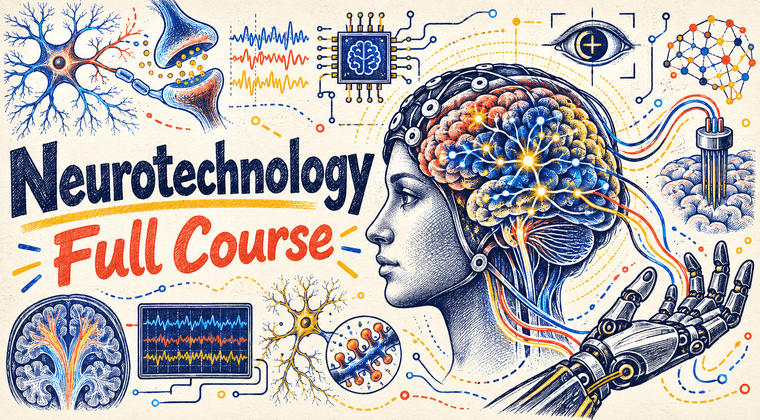
This course presents that discipline systematically across ten chapters, from the bioelectric origin of a neural signal through to the clinical, consumer and ethical questions the field faces today

Chapters
10
Lessons
10
Format
Self-paced video
Neurotechnology Bootcamp
Self-paced 10 lessons · watch anytime

About the course

Neurotechnology is the discipline of engineering methods that measure, interpret and influence the activity of the nervous system, spanning the brain, spinal cord, peripheral nerves and neuromuscular system. This course presents that discipline systematically across ten chapters, from the bioelectric origin of a neural signal through to the clinical, consumer and ethical questions the field faces today.

The course begins with the foundations of neurotechnology and the electrical basis of neural activity: the resting membrane potential, the action potential, and how the same underlying activity is expressed differently depending on recording scale. It then follows a signal through acquisition and recording, including electrodes, amplification and sampling, before dedicating full chapters to EEG and evoked potentials and to EMG, nerve conduction and peripheral neurotechnology. A further chapter surveys neuroimaging, from CT and structural MRI through functional MRI, diffusion imaging, PET and multimodal methods, examining the trade-off between spatial and temporal resolution that runs through every modality.

The course then moves into computation: neural signal processing, biomarker extraction, and the machine learning and deep learning methods now used to turn raw recordings into clinically useful information. It applies these foundations to brain-computer interfaces and neuroprosthetics, covering motor-imagery, P300 and SSVEP paradigms, non-invasive and intracortical interfaces, and neuroprosthetic limbs, and to neuromodulation, covering TMS, tDCS, tACS, deep brain stimulation, vagus nerve stimulation and the shift from open-loop to closed-loop control.

The course closes by connecting neurotechnology to neurorehabilitation, wearables and digital biomarkers, and by looking ahead to AI-driven and personalized neurotechnology, implantable and bidirectional interfaces, and the privacy, safety and career questions that will shape the field's next decade. By the end of the course, participants will be able to follow a neural signal from its biological origin through acquisition, analysis, interpretation and application, across the major technologies used in neuroscience and clinical neurotechnology today.

What you'll learn

Understand the Foundations and Biology Behind Neurotechnology

Learn what defines neurotechnology as a field, and how the resting membrane potential and the action potential give rise to the bioelectric activity that every recording, imaging and stimulation technology ultimately depends on.

Record, Image and Interpret Neural Activity Across Modalities

Build a working command of EEG, EMG and evoked potentials alongside structural and functional neuroimaging such as CT, MRI, fMRI and PET, including the trade-off between spatial and temporal resolution and how to recognize and manage noise and artefacts in real recordings.

Process Neural Signals and Extract Biomarkers Using Computational Methods

Apply time-domain and frequency-domain analysis, filtering and feature extraction, then extend this into machine learning and deep learning methods that turn raw neural data into biomarkers capable of supporting clinical decisions.

Design and Evaluate Brain-Computer Interfaces and Neuromodulation Systems

Understand how brain-computer interfaces decode intention from the nervous system for communication and movement restoration, and how neuromodulation technologies such as TMS, tDCS, DBS and vagus nerve stimulation intervene in neural activity through open-loop and closed-loop control.

Apply Neurotechnology in Rehabilitation and Anticipate Its Future

Connect these methods to real-world neurorehabilitation, wearables and digital biomarkers, and look ahead to AI-driven, personalized and implantable neurotechnology along with the privacy, ethical and career questions the field now faces.

Course curriculum

10 chapters · 10 lessons

  • Foundations of Neurotechnology

Meet your instructor

Prof. Srinivasa Chakravarthy
Lead instructor

Prof. Srinivasa Chakravarthy

Co-founder & Chief Scientist, Neurogati. Professor, IIT Madras

This course is led by Prof. Srinivasa Chakravarthy, Co-founder and Chief Scientist at Neurogati, a distinguished neuroscientist at IIT Madras with over 25 years of research experience. As the Head of the Computational Neuroscience Laboratory, his work focuses on computational neuroscience, brain-inspired systems, and neurotechnology applications.

What students say

“I came into this course knowing EEG and BCIs as buzzwords and left understanding how they actually connect, membrane potentials, electrodes, signal processing, decoding and stimulation all as one continuous pipeline rather than ten unrelated topics.”
— Avanthika